
TL;DR: Baker Brothers dispatches HVAC technicians for no-heat emergencies 24 hours a day, every day of the year, and arrival time during a cold front depends on three things: how close the nearest available technician is, how many calls are already in the queue and whether anyone in the home is at risk from the cold. The dispatcher gives you an expected arrival time on the call, and the first 10 minutes of troubleshooting below can sometimes get the heat back on before a truck is needed.
Baker Brothers answers no-heat calls 24 hours a day across Dallas-Fort Worth, and every call gets an expected arrival time before you hang up. A live person picks up, asks what the system is doing and sends the nearest available licensed HVAC technician. You shouldn't have to sit in a cold kitchen guessing.
“During a hard freeze, arrival times depend on how many calls are on the board and where our technicians are. Once a technician is assigned to you, they head your way as soon as they finish their current job, and you’ll get a 30- to 45-minute call-ahead so you’re not stuck waiting by the door. If someone in the home is especially vulnerable to the cold, tell the dispatcher. That moves you up the list.” - Roger Frosini, Vice President of HVAC, Baker Brothers Plumbing Air & Electric
You can control how ready the technician is when they arrive. Say what the system is doing ("the blower runs but the air is cold," "the thermostat screen is blank"), not what you think broke. Have the rough age of the system handy. Then use the wait to rule out the easy fixes and keep the house safe.
The first hard freeze of the season is usually the busiest heating night of the year in North Texas, and its timing is predictable. According to the National Weather Service in Fort Worth, DFW's average first freeze falls on November 22 and its average last freeze on March 12, based on records going back to 1898. Between those dates, most cold arrives as a front. Temperatures can fall sharply in a few hours, and every heating system in the metroplex gets asked to work at once.
Many of those systems haven't run a full heating cycle since last February. A furnace that sat idle through a Texas summer, or a heat pump that's only run in cooling mode since April, gets its first real test the first time temperatures drop into the 20s. Weak igniters, dirty flame sensors, failing capacitors and clogged filters that didn't matter in October show up all at once. That's why one cold night can put more no-heat calls on the board than a whole mild week.
North Texas houses add to the pressure. Many were built with summer cooling in mind, and many have ductwork running through unconditioned attics. A house that loses its heat source can fall below a comfortable temperature within hours on a freezing night. That turns a comfort problem into a safety problem faster than many homeowners expect.
“Every year, the first hard freeze shows us which systems got ignored all summer. Igniters, flame sensors, capacitors, dirty filters, parts that would have been a quick fix in October become a no-heat call at 2 a.m. Turn your heat on before the cold gets here, and you’ll know where you stand.” - Roger Frosini, Vice President of HVAC, Baker Brothers Plumbing Air & Electric
The simplest way to stay off that list is to run the heat on a mild October or early November day. A system that starts, runs and warms the house on a 55-degree afternoon has a much better chance of making it through the first freeze. If it doesn't, you've found the problem while technicians still have open schedules.
No heat is an emergency when the house is losing temperature in freezing weather, when someone at home is vulnerable to cold or when there's any sign of gas or carbon monoxide. If the system is running but struggling, and the house is holding a safe temperature, it can usually wait for a scheduled visit.
Situation | What to do |
|---|---|
Gas smell near the furnace or a carbon monoxide alarm going off | Get everyone outside now. Call 911 or your gas utility from outside. Call Baker Brothers for the repair only after the home is cleared. |
No heat at all, freezing temperatures outside, indoor temperature falling | Emergency. Call now, especially overnight. |
No heat and an infant, older adult or someone with a cold-sensitive health condition at home | Emergency. Call now and tell the dispatcher who's in the house. |
System runs, but the house won't stay above the mid-60s in a freeze | Call tonight. Arrival may be later depending on volume. |
Heat works but short-cycles, makes a new noise or warms unevenly | Usually safe to schedule for the next available visit. |
Heat pump shows "EM heat" or "AUX heat" during a hard freeze but the house is warm | Often normal in very cold weather. Watch it, and call if it keeps running after temperatures rise. |
The mid-60s threshold comes from federal guidance. The U.S. Department of Health and Human Services' FY2023 LIHEAP guidance says 64 degrees or higher is usually a safe indoor temperature for a healthy household. Homes with older adults, babies, young children or anyone with a chronic illness should stay between 68 and 70.
Heat pumps raise their own questions on cold nights, especially when the thermostat switches to backup heat. Baker Brothers' emergency heating service page explains what emergency heat mode means and when it signals a real problem.
A good share of no-heat calls come down to something a homeowner can safely check before a technician is dispatched. Work through these in order, and stop if anything smells like gas or burning.
What not to do: don't press a furnace reset button again and again, don't relight a pilot you're unsure about and don't take panels apart beyond the door. Repeated resets can mask a failed part and turn a simple repair into a bigger one.
“On first-freeze calls, I’ll often find a thermostat set to the wrong mode, a furnace switch bumped off or a filter so clogged the system shut itself down. Those are things a homeowner can check in a few minutes. If the basics look fine and you still don’t have heat, that’s when it’s time for us.” - Matt McFarland, HVAC Technician, Baker Brothers Plumbing Air & Electric
If you've worked through the list and still have no heat, call. Tell the dispatcher what you already checked, because it saves the technician time at the door.
The wait carries its own risks, and improvised heat is one of the biggest.
Then protect the pipes. Texas A&M AgriLife Extension notes that pipes can freeze and burst when the outdoor temperature reaches 20 degrees or below. Pipes in attics, garages and exterior walls are the most exposed. Open the kitchen and bathroom cabinet doors on exterior walls so indoor air can reach the plumbing, and let a faucet on an exterior wall drip. If a pipe does freeze or burst, shut off the main water valve and call. A Baker Brothers plumbing technician can take that call too. For more on freeze prep, see How to Prepare for Cold Weather and Prevent Frozen Pipes.
A no-heat call at 2 a.m. runs on the same standard as a scheduled tune-up on a Tuesday afternoon: diagnose first, show the homeowner the problem and put a firm price in writing before anything is repaired. Cold and tired is exactly when a homeowner is most likely to say yes to whatever is put in front of them, which is exactly why the standard matters most on a freezing night.
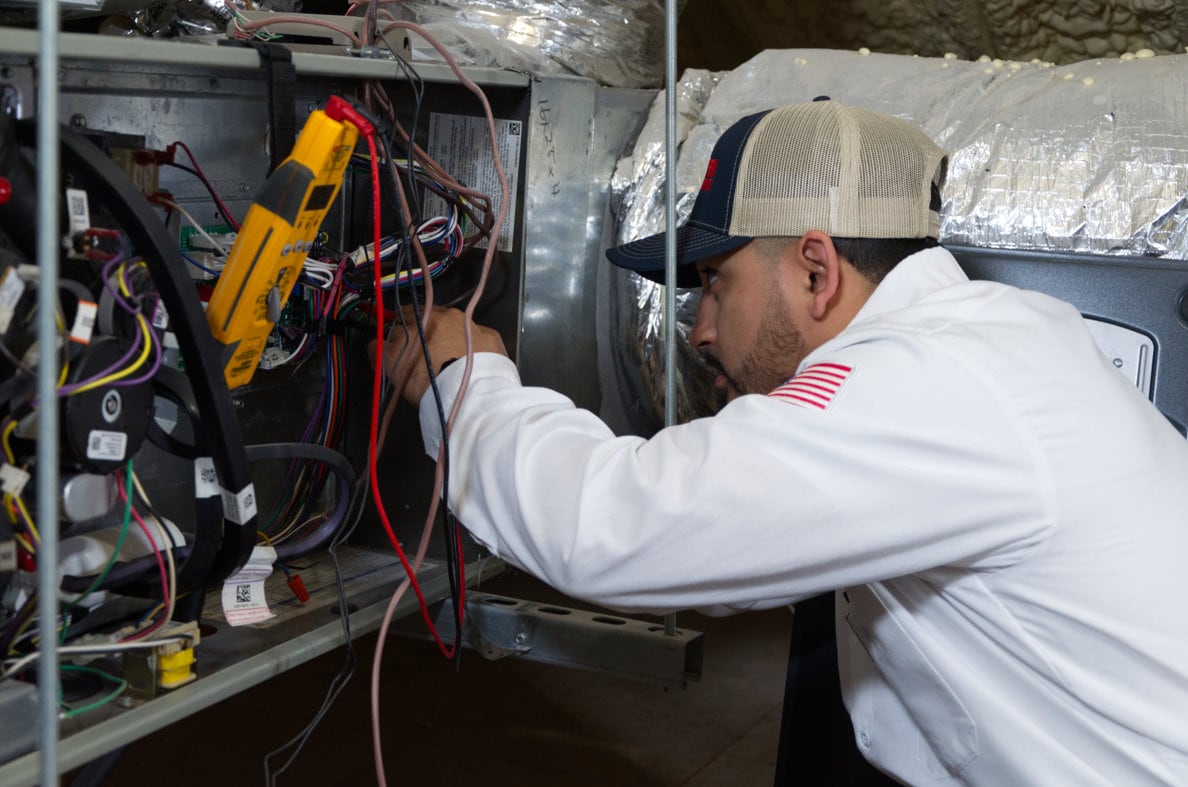
The technician confirms what the system is doing, tests the components that control ignition, airflow and safety and finds the actual failed part. You see it, whether that's a cracked igniter, a burned-out capacitor or a flame sensor coated in residue. You get options. Repair comes first when repair makes sense, and replacement is a separate conversation you don't have to have at 3 a.m. Nothing gets fixed until you approve the price. Baker Brothers trucks carry common replacement parts, so most no-heat repairs are finished on the first visit. When a part does need to be ordered, the technician talks through how to keep the house warm in the meantime.
What that looks like on a freezing night: On the first hard freeze of last winter, a Keller homeowner called in around 10 p.m. when their furnace was running but only cold air was coming out. The Baker Brothers technician traced it to a failed igniter, showed the homeowner the cracked part and gave a firm price before starting work. The replacement igniter was already stocked on the truck, so the heat was back on within about an hour of arrival. Before leaving, the technician ran the furnace through a full heating cycle and checked that warm air was reaching every room.
The work is backed by Baker Brothers' make-it-right guarantee. If the heat goes out again because of the repair, Baker Brothers comes back and makes it right. You don't have to fight for it.
Preventive maintenance is the surest way to avoid a first-freeze call. Families on the Baker Brothers Family Plan get a seasonal heating tune-up and inspection that tests the parts most likely to fail on the first cold night, along with member pricing on repairs. For routine service, see Dallas furnace repair and maintenance.
Baker Brothers dispatches HVAC technicians for no-heat emergencies 24 hours a day across Dallas-Fort Worth. Arrival time depends on how close the nearest available technician is, how many calls are already in the queue and whether anyone in the home is vulnerable to cold, and the dispatcher gives you an expected arrival time on the call.
No heat is an emergency when outdoor temperatures are freezing and the house is losing heat, when an infant, older adult or someone with a cold-sensitive health condition lives there or when there is any gas smell or carbon monoxide alarm. A system that runs but heats unevenly or makes a new noise can usually wait for a scheduled visit.
Check that the thermostat is set to Heat and above room temperature, reset a tripped HVAC breaker once, confirm the furnace power switch is on, replace a badly clogged filter and make sure the furnace door panel is fully closed. If the heat still won't come on, or a breaker trips a second time, call a licensed HVAC technician.
Never use a gas oven, grill, camp stove or generator to heat a home, because they can cause carbon monoxide poisoning. Space heaters can be used carefully if they're kept at least three feet from anything that can burn, plugged directly into a wall outlet and turned off when no one is in the room.
Yes. Letting a faucet on an exterior wall drip and opening sink cabinet doors helps protect pipes when a house loses heat in freezing weather. Texas A&M AgriLife Extension notes that pipes can freeze and burst once outdoor temperatures reach 20 degrees or below.
Roger is VP of HVAC at Baker Brothers Plumbing, Air & Electric, a licensed plumbing, HVAC and electrical contractor serving the Dallas-Fort Worth metroplex since 1945. He joined the company in 2013 to launch its HVAC division and now oversees heating and air conditioning service across its Dallas-Fort Worth locations. Roger brings more than 40 years of home services experience, having grown up in his father’s HVAC and construction business and later owning and operating two HVAC and construction companies in the DFW metroplex. He holds a Texas ACR license through TDLR along with EPA Section 608 and NATE certifications.
This post reflects Baker Brothers' emergency dispatch and on-site diagnostic process as published on bakerbrothersplumbing.com as of October 2026, combined with public safety guidance and climate data from the federal, state and nonprofit sources cited below. No competitor data or third-party pricing was used.
-

Open Mon-Sun 7am to 7pm
CRAIG FOSTER, M-36735 | TACLB00052136E | TECL 33750
Baker Brothers Dallas
2615 Big Town Blvd
Dallas, TX, 75150
Phone: 214-892-2225
Baker Brothers Arlington
7315 E Commercial Blvd
Arlington, TX 76001
Phone: 817-595-0116
Baker Brothers McKinney
7300 State Highway 121, Suite 300,
McKinney, TX 75070
Phone: 972-486-9882
Baker Brothers Keller
9500 Ray White Rd, Suite 200,
Keller, TX 76244
Phone: 817-900-3836
About Us :: Contact Us :: Blog :: Careers :: Family Plan :: Service Areas :: Sitemap :: Notice at Collection :: Your Privacy Choices :: Privacy Policy :: Terms of Use :: Financing
© 2026 Baker Brothers Plumbing, Air & Electric. All Rights Reserved