
TL;DR: A Federal Pacific Electric (FPE) Stab-Lok panel is a documented fire risk: government-commissioned testing found its breakers fail to trip on overload at rates far above other brands. The trade often calls these panels recalled, but the CPSC never issued a formal recall; it closed its investigation in 1983 citing insufficient evidence, not safety. Here's how to identify one in a Dallas-Fort Worth home, what it actually means for your insurance and resale and what replacing it involves.
In 1982, under Contract CPSC-C-81-1429, an independent lab tested 122 two-pole Federal Pacific Stab-Lok breakers against their rated calibration. Twenty-five percent failed to trip at 135% of rated load before any mechanical cycling. Measured pole-by-pole rather than pair-by-pair, the individual failure rate ran as high as 51% before cycling and 65% after the breakers had been operated a few times, the way a breaker actually gets used over years in a working panel.
That failure mode matters more than the percentage alone. A breaker's entire job is to open the circuit when current exceeds a safe level. When a Stab-Lok breaker stays closed under an overload or short circuit, current keeps flowing into wiring that was never sized to carry it, and the conductors and connections generate heat with nothing left to stop them.
Independent engineer Jesse Aronstein, who has tested FPE breakers for more than two decades, has put the national toll at roughly 2,000 house fires a year linked to FPE panels, a figure reported in an NBC Bay Area investigation that also included testing from Dr. Bernard Cuzzillo, a fire-cause engineer at Berkeley Research Company. In that testing, a 60-amp double-pole breaker carrying twice its rated current stayed closed for more than four minutes before anything happened. Cuzzillo's explanation was mechanical: the internal trip mechanism can physically stick, so the breaker never gets the signal to open at all.
“When one of our technicians opens a panel and sees those orange Stab-Lok breakers, it gets flagged right away. The problem is that these breakers can look perfectly fine and still fail to shut off power during an overload or short circuit. If you’ve got one, don’t wait. Have a licensed electrician come out and take a look as soon as you can.” - James Sotero, Vice President of Electrical, Baker Brothers Plumbing Air & Electric
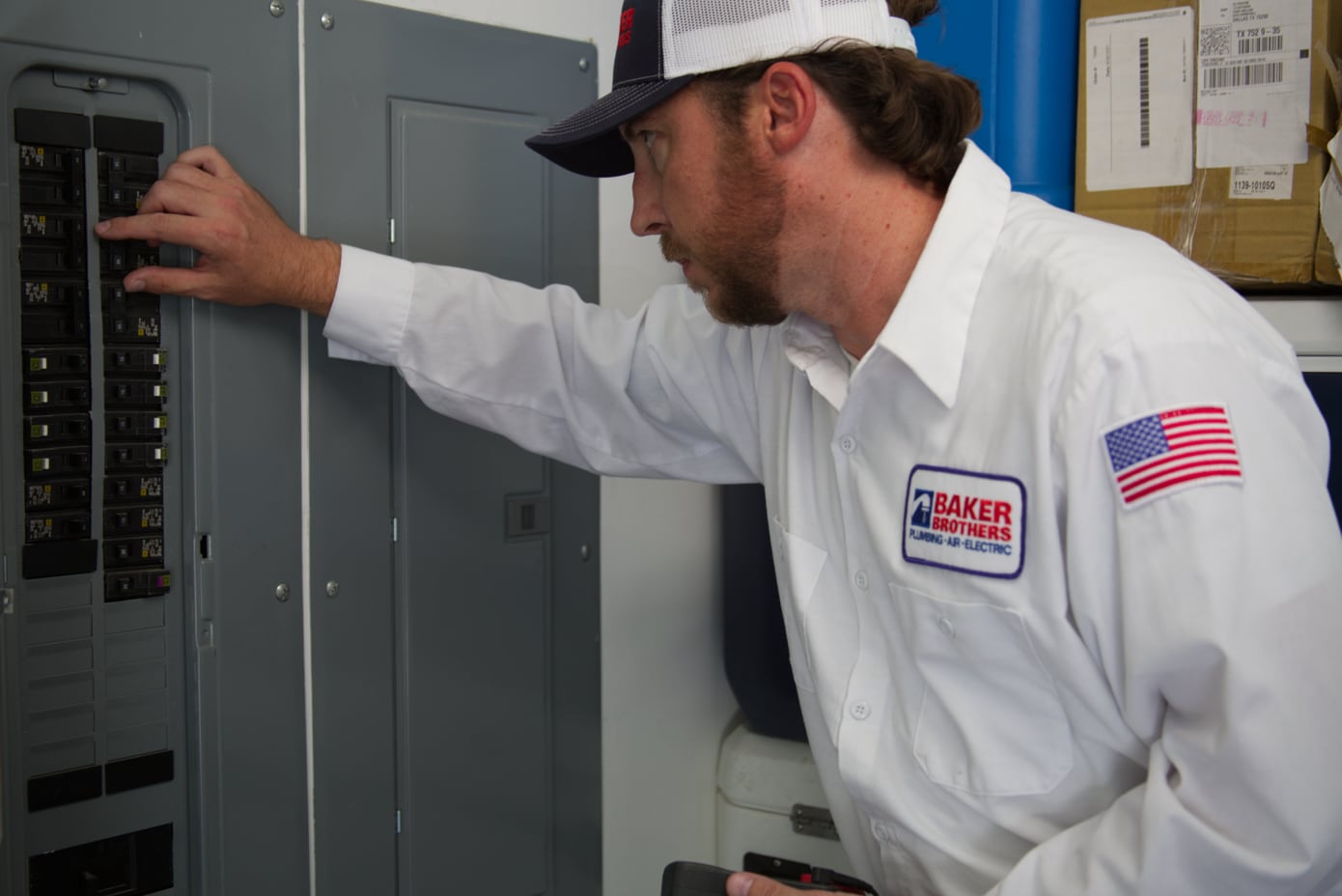
Start at the panel door, not the internet. Federal Pacific Stab-Lok panels have one visual signature that is hard to miss once you know it: breaker switches with distinctive orange handles, arranged in the panel's interior. Open the panel cover (never remove a breaker or touch anything inside) and look for a nameplate reading "Federal Pacific Electric" or "FPE" stamped on the inside of the door or the panel tub itself.
Age is a useful second signal. FPE panels were installed heavily from the 1950s through the early 1980s, which puts them in older pockets of East Dallas and Arlington and in the pre-1990 sections of McKinney, Allen and similar established DFW neighborhoods more often than in the newer growth corridors further out. If your home's electrical service has never been touched since it was built and falls in that age range, it is worth a look.
Zinsco and Sylvania-Zinsco panels carry a related but separate hazard, with vertical, multicolored breakers rather than Stab-Lok's orange ones; our detailed McKinney guide to Federal Pacific and Zinsco panels covers that brand's failure pattern specifically if that is what you find instead.
Once you have a visual match, stop there. Do not test the panel by intentionally overloading a circuit to see what happens, and do not attempt to replace or modify breakers yourself. A licensed electrician can confirm the brand and assess actual condition with a proper electrical safety inspection far more accurately than a homeowner working from photos online.
The moment an FPE panel shows up on paper, it stops being a private matter between you and your electrical system. A home inspection during a sale routinely flags Federal Pacific and Zinsco panels by name, and many DFW insurance carriers treat that flag as a condition of coverage rather than a suggestion: some will not write a new policy on a home with one in place, and others will decline to renew an existing policy until it is replaced. None of this requires a federal recall to happen. Carriers set their own underwriting standards based on documented loss history and engineering data, and FPE's history qualifies on both counts even without a CPSC order behind it.
For a seller, that usually means the panel gets replaced before closing, often on a timeline set by the buyer's lender rather than by the seller's preference. For an owner who is not selling, the more common trigger is a renewal notice or a routine inspection that surfaces the same flag years before any sale is on the table.
Here’s how that often plays out. A Garland homeowner accepts an offer, and the buyer’s home inspection flags a Federal Pacific panel. The buyer asks for it to be replaced before moving forward. The seller calls Baker Brothers, and we replace the panel, pull the permit and schedule the city inspection. Once the new panel passes, the seller hands the inspection documentation to the buyer, and the sale closes on schedule with a panel that meets current code.
Panel replacement is permitted, inspected electrical work that goes through several required steps before the job is done. A licensed electrician evaluates your home's actual electrical load first, since the goal is not simply removing the FPE panel but sizing the replacement correctly for the circuits, appliances and any future additions like an EV charger. From there, the electrician pulls a permit, coordinates a temporary power shutoff with the utility (Oncor across most of the DFW metro), installs a modern, code-compliant panel and schedules the final inspection sign-off. None of this is a do-it-yourself project, both because of the permit requirement and because working inside a live panel that is already known to fail its own safety function carries real risk.
For homeowners who are already committing to a panel replacement, it is worth deciding what to install rather than defaulting to a like-for-like swap. Baker Brothers is now an authorized SPAN smart panel installer, which gives homeowners real-time circuit-level monitoring through a mobile app and prepares the home's electrical service for a future EV charger, solar, battery storage or a heat pump without a second service upgrade down the road. A panel replacement triggered by an FPE flag is often the one moment when that upgrade makes the most financial sense, since the labor and permitting work is happening anyway.
Baker Brothers handles panel replacement throughout the DFW metro, with dedicated pages for McKinney (including a cost breakdown), Dallas and Arlington covering what drives the price in each service area.
No recall is not the same as a clean bill of health, and in this case the record says the opposite about as clearly as a government document ever does. The CPSC's own 1983 closure notice, revised as recently as 2011, explicitly declines to call these panels safe. A federal test contract measured real failure rates well above what a functioning breaker should show, and a New Jersey court separately found that Federal Pacific had misrepresented its own safety testing to consumers. None of that requires you to panic, but all of it is public record, and it is enough to justify a five-minute look at your own panel door.
If your panel has orange Stab-Lok breaker switches or a nameplate reading Federal Pacific Electric or FPE, or if you would simply rather have a licensed electrician confirm it than guess from a blog post, schedule an electrical inspection with Baker Brothers and get a straight answer about what is behind your panel door.
No. There is no law or code requirement forcing removal of an existing FPE panel, and no federal recall has ever been issued. Many jurisdictions and insurers still allow the panels to remain in place, though a growing number of carriers require replacement as a condition of coverage.
Yes, but expect it to come up. Home inspectors routinely flag FPE and Zinsco panels by name, and many buyers or their lenders will ask for the panel to be replaced before closing rather than accepting it as-is.
Generally no. Panel replacement driven by an FPE flag is typically treated as a homeowner-funded safety upgrade rather than a covered repair, and in many cases the replacement is what restores or maintains your ability to get coverage at all, rather than something the policy pays for.
Cost depends on your home's amperage needs, wiring condition and whether any code-required upgrades come with the job, so there is no single flat number. A licensed electrician can give you an exact figure after an in-home assessment.
Not safely, and in most cases not practically. The failure documented in CPSC-commissioned testing is in the Stab-Lok breaker design itself, and FPE-compatible replacement breakers carry the same underlying design and calibration concerns as the originals. A full panel replacement with modern, correctly calibrated breakers is what resolves the hazard.
Open the panel door (without touching anything inside) and look for orange switch handles and a nameplate reading Federal Pacific Electric or FPE. Zinsco panels use vertical, multicolored breakers instead of orange ones. If you are not confident reading the panel yourself, a licensed electrician can identify it in minutes during an inspection.
James Sotero is Vice President of Electrical at Baker Brothers Plumbing, Air & Electric, a licensed plumbing, HVAC and electrical contractor serving the Dallas-Fort Worth metroplex since 1945. As the company’s Responsible Master Electrician, James oversees all electrical services and brings nearly 30 years of experience in the field. His leadership helps ensure every electrical job is completed safely, to code and with the homeowner’s needs in mind.
This post reflects Baker Brothers Plumbing, Air & Electric's professional perspective as a licensed DFW electrical contractor, drawing on the company's experience replacing Federal Pacific and Zinsco panels across the Dallas-Fort Worth metroplex. Failure-rate and investigation results are drawn directly from the primary sources listed below rather than restated secondhand.
U.S. Consumer Product Safety Commission, Commission Closes Investigation of FPE Circuit Breakers and Provides Safety Information for Consumers, Release 83-008, originally issued March 3, 1983, revised February 18, 2011
CPSC Contract CPSC-C-81-1429 breaker calibration test data, as compiled in InspectApedia's FPE CPSC Investigation summary
Jesse Aronstein engineering research and Dr. Bernard Cuzzillo / Berkeley Research Company testing, as reported by NBC Bay Area, "Federal Pacific Circuit Breakers: Investigation Finds Decades of Danger"
InspectApedia FPE Stab-Lok Hazard Summary, including the 2002 New Jersey Superior Court class-action finding (Docket No. L-2904-97)
Electrical Safety Foundation International (ESFI), general home electrical safety guidance
Baker Brothers: Federal Pacific and Zinsco Panels: Why They're Dangerous and Uninsurable in McKinney
-

Open Mon-Sun 7am to 7pm
CRAIG FOSTER, M-36735 | TACLB00052136E | TECL 33750
Baker Brothers Dallas
2615 Big Town Blvd
Dallas, TX, 75150
Phone: 214-892-2225
Baker Brothers Arlington
7315 E Commercial Blvd
Arlington, TX 76001
Phone: 817-595-0116
Baker Brothers McKinney
7300 State Highway 121, Suite 300,
McKinney, TX 75070
Phone: 972-486-9882
Baker Brothers Keller
9500 Ray White Rd, Suite 200,
Keller, TX 76244
Phone: 817-900-3836
About Us :: Contact Us :: Blog :: Careers :: Family Plan :: Service Areas :: Sitemap :: Notice at Collection :: Your Privacy Choices :: Privacy Policy :: Terms of Use :: Financing
© 2026 Baker Brothers Plumbing, Air & Electric. All Rights Reserved