
TL;DR: Snaking clears a path through a clog, but it doesn't fix what caused it: if the problem is a corroded pipe, invading tree roots or a section of pipe that has physically sagged out of level, the backup returns within weeks no matter how many times you snake it.
Baker Brothers is a licensed Dallas-Fort Worth plumbing, HVAC and electrical company, and drain and sewer diagnostics are part of what our technicians handle every week. If you're on your third or fourth call about the same drain, that repetition is telling you something. A cable can punch a hole through almost anything sitting in a pipe. It can't fix a pipe.
Snaking clears what's blocking a pipe. It does nothing to fix why the pipe keeps blocking. A drain snake is a mechanical cable with a head on the end: an auger, a cutting blade or a retrieval hook, depending on the job. Run it down a clogged line and it bores through whatever is in the way, restoring drainage. For a single, isolated clog, like a wad of hair in a bathroom drain or a buildup of food scraps in a kitchen line, that's the whole fix. The obstruction is gone and stays gone, because nothing about the pipe itself was ever the problem.
The trouble starts when the blockage is a symptom of something structural. A snake clears a path roughly the width of its cable head. It doesn't scour the pipe walls, it doesn't reshape a section of pipe that has settled out of grade, and it doesn't remove roots that are still alive and growing outside the pipe. If any of those are the cause, the cable buys a few days or a few weeks of clear flow before the same material, the same roots or the same standing water rebuilds the blockage in the same spot.
The same limit applies to hydro jetting, which scours the full width of a pipe instead of just boring a path and is genuinely the better call for buildup-driven recurring clogs. But even jetting can't fix a pipe that's cracked, corroded or has lost its slope. For the full comparison of when each method applies, see our Snaking or Hydro Jetting? A Dallas Homeowner's Decision Guide.
A bellied pipe, a low section where the line has sagged out of its slope so gravity can no longer pull waste through it on its own, is a cause that gets far less attention than roots or corrosion. It's also a particularly North Texas problem.
Sewer lines are laid at a slight, continuous downward slope so gravity moves wastewater to the city main. A belly is a low spot in that line where the pipe has settled or shifted so a section sits below the grade of the pipe around it. Water and solid waste pool in that low point instead of passing through. Every time the line is cleared, the low spot fills right back up, because the problem was never what was sitting in the pipe: it's the shape of the pipe itself.
Dallas-Fort Worth sees more of these than most regions for a specific reason: the area sits on expansive clay soil, much of it part of the Blackland Prairie that runs through North and Central Texas. According to Texas A&M AgriLife's Blackland Research & Extension Center, which has studied this soil for decades, it swells when it absorbs water and shrinks as it dries out, sometimes by several inches across a single wet-to-dry cycle. A pipe buried in soil that's expanding and contracting under it doesn't stay level forever. Joints separate slightly and low points form gradually, often over years, with no visible warning above ground until the drain starts backing up on a schedule.
“When we run a camera through a line we’ve just cleared and there’s still water sitting in one stretch, that’s usually a belly. The question we’re answering is whether that’s leftover blockage or the pipe itself has dropped out of slope. If it’s the pipe, we’ll tell you that up front and recommend a solution that addresses the cause, because another cleaning won’t correct a sagging pipe. - Garrett Bullard, Licensed Plumber, Baker Brothers Plumbing, Air & Electric
A belly can't be snaked or jetted away, because nothing about the pipe changes when it's cleaned. Hydro jetting scours the standing water and debris out of the low spot and the line drains clear for a while, then fills again, because the low point itself is still there. The fix has to address the pipe's shape: a spot repair on the sunken section, a trenchless lining, or, for a more significant sag, replacing that run of pipe at the correct slope. Our Sewer Line Repair Options: Spot Repair, Lining, or Replacement guide walks through how we decide between those three.
A sagging pipe belly is only one of several structural causes behind a drain that keeps clogging after it's been cleared. Here's the short version of the other three types, and where to go for the full picture.
Corroded cast iron. Homes built before 1980 in DFW commonly have cast iron drain lines, and cast iron corrodes from the inside as it ages. The smooth interior wall roughens into scale, and that rough surface snags grease, paper and waste the same way a scratched cast-iron skillet catches a paper towel. A one-time clog clears and stays clear; a cast iron scale clog comes back within weeks because the pipe material itself has changed, not just what passed through it. See What Causes Recurring Drain Clogs in Older Dallas Homes? for the full breakdown, including how descaling, lining and replacement compare for aging cast iron.
Tree roots. Roots are drawn to the moisture, nutrients and oxygen inside a sewer line, and they find their way in through hairline cracks or loose joints, both more common in older DFW infrastructure. Snaking or jetting can cut roots out of the pipe, but the roots themselves are still alive outside it. Cutting them back without addressing the entry point tends to stimulate faster regrowth, the same way pruning a hedge does, which is why root-related backups often return on a predictable few-month cycle. Our Tree Roots in Your Sewer Line guide covers how we confirm root intrusion and the repair options once it's confirmed.
Grease and hard water scale. North Texas water runs hard, and the same mineral scale that shows up as white crust on a faucet also builds up inside drain and sewer lines, narrowing the opening and giving grease and debris a rough surface to cling to. This kind of buildup responds well to hydro jetting, which scours the full pipe wall rather than boring a path through it, but if the water stays hard and habits like grease down the kitchen drain don't change, the scale reaccumulates over time. See How North Texas Hard Water Affects Your Drains and Pipes for what we look for and how a whole-home water softener fits into the fix.
You can't diagnose a bellied pipe, root intrusion or interior corrosion by looking down a drain, and it's not worth guessing before you pay for another cleaning. A few things worth noting before you call, though, will help a technician get to the right answer faster:
None of these observations replace a proper diagnosis. They just help you describe the problem accurately, which is the difference between a technician guessing and a technician confirming.
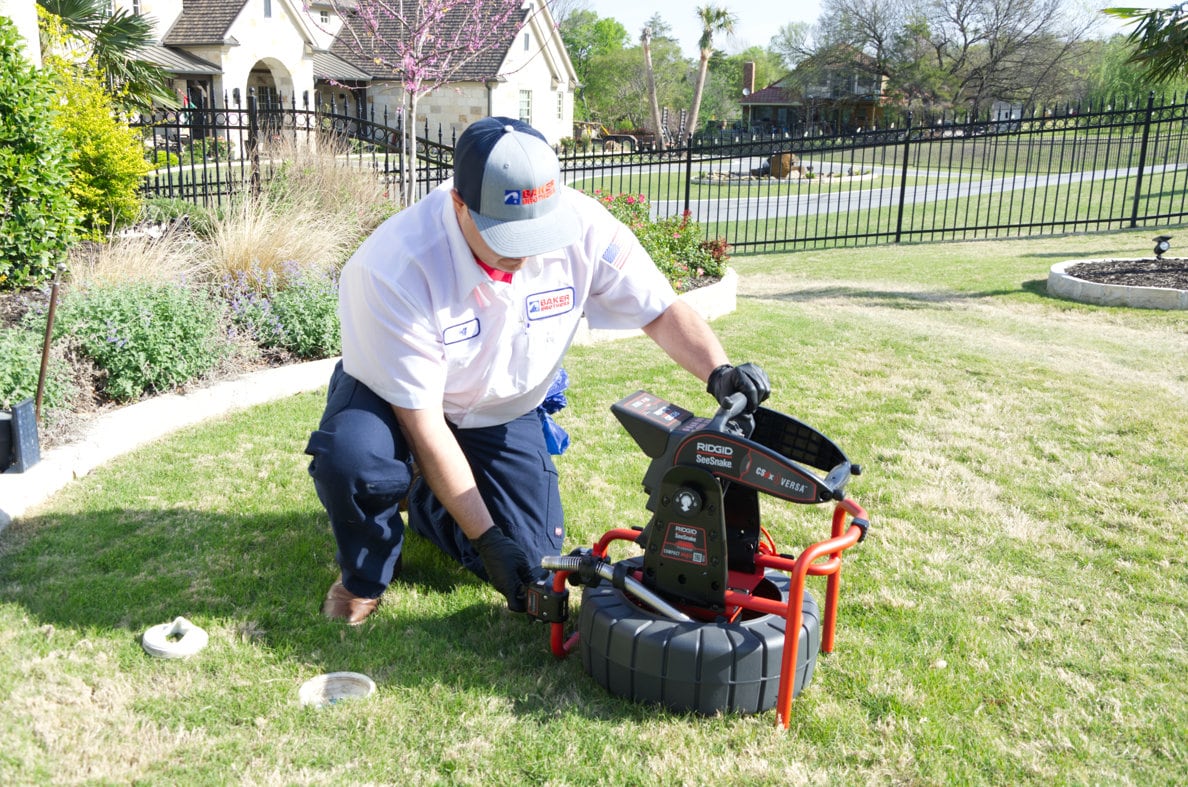
A camera inspection is the step that separates a permanent fix from another few weeks of relief. Running a sewer camera through the line after a clog has been cleared shows exactly what's happening inside the pipe: a belly holding standing water, roughened cast iron, root intrusion, a crack or nothing structural at all, in which case a straightforward cleaning really was the right call. Baker Brothers has run video sewer inspections since 1988, and it's the step that turns "we cleared it again" into "here's what's actually wrong and here's what fixes it." For more on how we scope that inspection, see What Affects the Cost of a Sewer Camera Inspection in Dallas.
That’s why our technicians don’t treat a repeat backup as just another clog. Fort Worth’s own sewer data shows how often the pipe itself is the problem: of the overflows in its system from 2008 to 2017, 45% were caused by debris buildup, often where flow slows in a sagging section of pipe. Another 209 were traced to tree roots and 143 to structural pipe failure. Those are city mains, but the line under your yard deals with the same roots, the same shifting clay and the same sags. Finding which problem you’re dealing with is the difference between paying for the same cleaning again and paying once for the repair that ends it.
Once the cause is confirmed, the fix follows from what the camera shows: descaling or lining for scaled cast iron, root removal with a repair at the entry point for root intrusion, or a spot repair, lining or section replacement for a bellied line. None of those are guesswork fixes, and none of them require tearing up a yard to figure out where to dig: the camera tells us that too.
If you're dealing with a drain that's been snaked more than once this year, it's also worth asking about our current $79 drain cleaning special, which includes a free video inspection, so if the problem is more than a simple clog, you'll know before you're back on the calendar a third time. Baker Brothers' Family Plan members also get priority scheduling and maintenance pricing on drain and sewer work, which matters more for a pipe with a real, ongoing issue than for a one-time clog.
Snaking clears a path through whatever is blocking the pipe, but it doesn't fix a structural cause behind the blockage. If the problem is a bellied section of pipe holding standing water, corroded cast iron shedding scale or tree roots growing back into the line, the same blockage rebuilds itself, usually within days to a few weeks of the last cleaning.
An occasional repeat clog from a habit, like grease going down a kitchen drain, isn't unusual and is often fixed by changing that habit. A drain that needs snaking every few weeks despite no change in use is not normal and is a sign the pipe itself has a problem worth inspecting with a camera.
The clearest sign is a drain that clears completely after cleaning and then backs up again within days to a couple of weeks, especially if multiple fixtures back up together. A camera inspection is the only way to confirm a belly, since the sag happens underground with nothing visible above ground to signal it.
Hydro jetting fixes buildup-driven clogs that snaking can't, because it scours the full width of the pipe instead of boring a single path through the blockage. It cannot fix a structural problem like a bellied pipe, a crack or severe corrosion. Jetting will clear those temporarily, but the underlying issue and the recurring clog remain.
Coverage varies significantly by policy and by the cause of the damage, and most standard homeowners policies exclude gradual issues like soil-related settling or aging pipe wear unless a specific sewer line endorsement was added. This is general information, not a determination of your coverage. Check your specific policy or ask your insurance provider before assuming either way.
If the same drain or the same section of line has needed cleaning more than twice in a matter of months, that pattern alone is a reason to ask for a camera inspection rather than another cleaning. Confirming the cause before the third or fourth service call is usually less expensive than continuing to pay for cleanings that only last a few weeks.
Garrett Bullard has proudly called Baker Brothers home for his entire career. A licensed Journeyman Plumber, he joined the company in 2011 and is celebrating 15 years of service this year. What Garrett loves most about Baker Brothers is watching the company continue to grow and evolve every day.His work includes drain and sewer diagnostics and camera inspections, helping homeowners understand recurring plumbing problems and their options for a lasting solution .
This post reflects Baker Brothers' field experience diagnosing recurring drain and sewer backups across the Dallas-Fort Worth area, cross-referenced against Baker Brothers' own published guidance on cast iron corrosion, tree root intrusion and hard water scale, and against regional soil data from Texas A&M AgriLife's Blackland Research & Extension Center.
-

Open Mon-Sun 7am to 7pm
CRAIG FOSTER, M-36735 | TACLB00052136E | TECL 33750
Baker Brothers Dallas
2615 Big Town Blvd
Dallas, TX, 75150
Phone: 214-892-2225
Baker Brothers Arlington
7315 E Commercial Blvd
Arlington, TX 76001
Phone: 817-595-0116
Baker Brothers McKinney
7300 State Highway 121, Suite 300,
McKinney, TX 75070
Phone: 972-486-9882
Baker Brothers Keller
9500 Ray White Rd, Suite 200,
Keller, TX 76244
Phone: 817-900-3836
About Us :: Contact Us :: Blog :: Careers :: Family Plan :: Service Areas :: Sitemap :: Notice at Collection :: Your Privacy Choices :: Privacy Policy :: Terms of Use :: Financing
© 2026 Baker Brothers Plumbing, Air & Electric. All Rights Reserved