
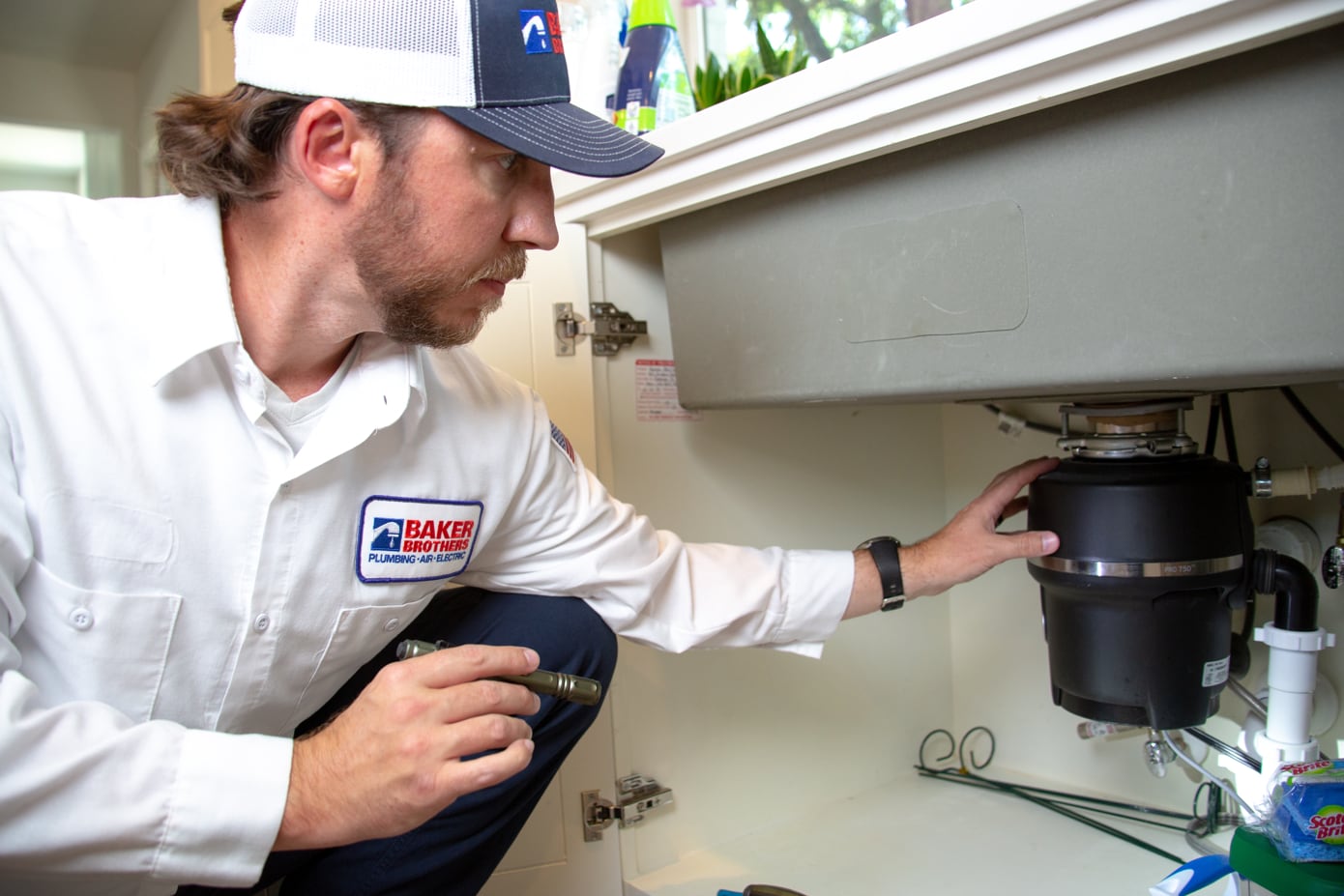
TL;DR: A garbage disposal handles small amounts of everyday soft food scraps fed slowly under cold running water. Grease, fibrous peels, pasta, rice, large bones, pits and anything that isn't food belong in the trash, and in older DFW homes the clog usually forms in the drain pipes past the disposal.
Most kitchen sink clogs we're called out for didn't start with a broken disposal. They started with a habit: the bacon grease poured in "with plenty of hot water," the potato peels from a big family dinner, the coffee grounds rinsed down every morning for years. Here's what your disposal can handle, what it can't and how to tell when a slow sink has become a bigger problem.
A garbage disposal is built for small amounts of soft, everyday food scraps. Think of it as the last step after you've scraped the plate into the trash. These are generally fine in modest amounts:
How you feed the disposal matters as much as what you feed it. Run a strong stream of cold water before you switch it on, add scraps a little at a time instead of all at once, and keep the water running for 15 to 20 seconds after the grinding sound changes. That extra water carries the ground food through the trap and into the main drain line instead of leaving it to settle in the pipe under your sink.
Cold water is the right choice for two reasons. It keeps the disposal's motor and seals from working harder than they need to, and it keeps any trace of fat solid so it can be ground and flushed rather than melted into a liquid that coats the pipe walls further down the line. If you're not sure whether something belongs in the disposal, put it in the trash.
Some items damage the disposal itself. Others pass through the disposal just fine and cause the clog further down the line, where it's harder and more expensive to reach. Both belong in the trash.
Item | What it does | Where it should go |
|---|---|---|
Grease, cooking oil, butter, fat trimmings | Coats pipe walls, cools and hardens into a clog that grows over time | Sealed container in the trash, or a city cooking oil drop-off |
Fibrous peels and stalks (celery, corn husks, onion skins, artichoke leaves, asparagus ends) | Long strands wrap around the disposal's spinning parts and tangle into a mat in the trap | Trash or compost |
Pasta, rice, oatmeal and potato peels | Keep absorbing water after they're ground, swelling into a thick paste in the trap | Trash |
Large bones, fruit pits and nuts | Too hard to grind; can jam the unit or wear down the grinding parts | Trash |
Non-food items (paper towels, napkins, twist ties, produce stickers, "flushable" wipes, cigarette butts) | Don't break down at all; catch other debris and start a clog | Trash |
Chemical drain cleaners | Harsh on the disposal's seals and on older pipes; dangerous if the unit has to be opened afterward | Don't use them; call a plumber instead |
Of everything in that table, grease is the one item that causes trouble in any amount, even a few spoonfuls at a time.
Starches cause their trouble after they're ground. A handful of rice or a pot's worth of pasta goes down easily and grinds quickly. The problem comes later, when those ground starches keep soaking up water in the trap and settle into a dense paste. Holiday cooking makes this worse, because the volume is so much higher than a normal weeknight.
These three show up on almost every "never put this in your disposal" list. The disposal itself can handle them; the risk is in the pipes past it.
Coffee grounds and eggshells won't damage a working disposal; they grind and pass through it. The trouble shows up downstream, when too much goes in at once or the drain line past the sink is already narrowed, and they settle into a clog or a slow drain.
Coffee grounds don't dissolve. They're fine, heavy particles that settle wherever water slows down, especially in the trap and in any low spot in the drain line. A few grounds now and then won't hurt. A daily rinse of the coffee filter for years builds a layer of sediment that eventually catches everything else.
Eggshells grind into a gritty, sand-like material that behaves the same way. They also don't "sharpen the blades," a common myth: most disposals use blunt impellers that push food against a grinding ring and have no sharp blades at all.
Small pieces of citrus peel are a common way to freshen a disposal and are generally fine in small amounts. Whole rinds or a bag's worth of peels after juicing are a different matter, because the thick, fibrous pith wraps around the grinding parts the way celery strings and corn husks do.
For DFW homes, our advice is to put grounds and shells in the trash or the compost bin. Many of the homes we work in have drain lines that are decades old, and those are exactly the lines where grounds and shell grit settle and build up. There's no reason to send sediment toward a pipe that's already narrowing.
To freshen a disposal, a few ice cubes followed by cold water and a small squeeze of dish soap does the job without leaving anything behind.
Grease should never go down the sink, with or without the disposal running and with or without hot water.
Kitchen drain clogs are among the most common calls our plumbers answer across DFW, and grease is behind most of them. It’s also why the same drain often clogs again a few months after it’s cleared. Keeping cooking fats and oils out of the sink is one of the simplest ways to help prevent these recurring blockages.
Grease clogs are stubborn because grease doesn't stay grease. Once it cools and coats the inside of a pipe, it mixes with food particles and the minerals in North Texas water and hardens into a waxy, soap-like layer that a quick snaking often pushes aside instead of removing.
The "pour it with hot water" approach doesn't work. Hot water keeps grease liquid only until it reaches a cooler stretch of pipe, usually somewhere you can't see, where it solidifies and starts catching food particles. Dish soap breaks grease up temporarily, but it doesn't stop the grease from re-forming downstream.
Dallas Water Utilities, which runs the city's Cease the Grease and Defend Your Drains programs, recommends this routine:
Many North Texas cities also run a seasonal Holiday Grease Roundup through the regional Defend Your Drains North Texas program, typically from mid-November into January, with drop-off sites for used cooking oil from holiday frying and roasting. Check your city's website for this year's dates and locations.
For a fuller look at grease clogs, including the warning signs that one is forming, see our guide to preventing grease and kitchen drain clogs.
The same disposal habits cause more trouble in an older home, because of what sits past the sink.
Many Dallas-Fort Worth homes built before the 1980s still have cast iron drain lines. Over decades, the inside of a cast iron pipe corrodes and roughens, the way a scratched cast-iron skillet catches a paper towel. That rough surface grabs grease, coffee grounds and starch that would slide through a smooth pipe, and the opening narrows a little more each year. We cover this in more detail in our article on recurring drain clogs in older Dallas homes.
Soil plays a role too. Much of DFW sits on the expansive clay of the Blackland Prairie, which Texas A&M AgriLife's Blackland Research & Extension Center has studied for decades. The soil swells when it's wet and shrinks when it dries, and over time that movement can cause sections of buried drain pipe to sag. A sagging section, often called a belly, holds standing water, and ground food settles right there. That's why "it was fine for years, and now the sink backs up every month" is such a common story in North Texas.
Hard water adds a third layer. Mineral scale narrows pipes from the inside and gives grease and food particles more surface to grip. See how North Texas hard water affects your drains and pipes for more.
“In an older line, we’re looking for rough spots in the cast iron or low spots where grease and food collect instead of washing through. We use a camera to help us see where the buildup is happening and whether the pipe itself is the reason the drain keeps backing up.” — Garrett Bullard, Licensed Plumber, Baker Brothers Plumbing Air & Electric
A humming or silent garbage disposal is usually something you can fix yourself in a few minutes, as long as the power is off before your tools go anywhere near it. If the disposal hums but doesn't spin, something is jammed in the grinding chamber.
If the disposal is completely silent, it may have tripped its internal overload. Press the reset button and check the breaker or GFCI outlet before assuming the motor has failed.
If the disposal still hums, trips the reset button again or won't run after these steps, the motor or wiring may need a plumber's attention.
A kitchen sink that backs up while the garbage disposal runs normally has a clog further down the drain, and that's usually a job for a plumber. Skip the chemical drain cleaner. It rarely clears a grease or starch clog, it's hard on older pipes and it makes the job more dangerous for whoever opens the line afterward. Call a plumber when:
Each of those points to a problem past the trap, often in the branch line or main sewer line. For a recurring kitchen clog, a Baker Brothers technician can run a camera down the line so you see what's in the pipe, whether that's grease buildup, a sagging section of pipe or corroded cast iron, and you get the diagnosis and a firm price in writing before any work starts.
A homeowner in Plano called us after their kitchen sink kept backing up in the days following Thanksgiving cooking. Our technician ran a camera down the line and found grease buildup with food debris trapped in it. After walking the homeowner through what the camera showed and getting approval on an upfront price, he cleared the line and confirmed the sink was draining normally again. Before leaving, he also went over the simplest way to keep it that way: grease in a container, not down the drain.
The weeks between Thanksgiving and New Year's are hard on kitchen drains. More people, more cooking, more grease and more dishes all hit the same pipe in a short window, and house guests don't always know your disposal rules.
The weeks between Thanksgiving and New Year’s are hard on kitchen drains. More people, more cooking, more grease and more dishes all hit the same pipe in a short window, and house guests don’t always know your disposal rules. The days after Thanksgiving are some of our busiest of the year for kitchen drain calls. A little preparation keeps the holidays from ending with a service call:
If your kitchen drain has been slow for a while, it's worth having it looked at before the holidays rather than in the middle of them.
A garbage disposal is designed for small amounts of soft, everyday food scraps, such as fruit and vegetable trimmings cut into small pieces, plate scrapings and soft cooked leftovers. Feed scraps gradually with a strong flow of cold water, and keep the water running for 15 to 20 seconds after grinding to flush the waste through the pipes.
Coffee grounds won't damage the disposal itself, but they don't dissolve, and they settle in the trap and in low spots in the drain line. Over time that sediment can cause a slow drain or a clog, especially in older homes with cast iron or sagging drain lines, so the trash or compost bin is the better place for them.
No. Hot water keeps grease liquid only until it reaches a cooler section of pipe, where it hardens and starts catching food particles. Let grease cool, pour it into a sealable container and put it in the trash, or take larger amounts of cooking oil to a city recycling drop-off.
Use cold water. Cold water keeps any fats solid so they can be ground and flushed instead of coating the pipe walls, and it's what Baker Brothers plumbers recommend for everyday use.
A sink that backs up while the disposal runs normally usually has a blockage past the disposal, in the trap, branch line or main sewer line. Repeat clogs, both sides of a double sink backing up or other drains gurgling are signs to have a plumber inspect the line, often with a camera.
Turn off the power, remove any visible object with tongs or pliers, then use a hex wrench in the socket on the bottom of the unit to free the grinding plate. Press the red reset button, restore power and test it with cold water running. If it still hums or trips again, it's time to call a plumber.
Garrett Bullard is a licensed Journeyman Plumber at Baker Brothers Plumbing, Air & Electric, where he has spent his entire 15-year career. He specializes in drain and sewer diagnostics and camera inspections, helping homeowners understand what’s behind recurring plumbing problems and their options for a lasting fix.
This article reflects the professional perspective of Baker Brothers' plumbing team, based on field experience clearing kitchen drains and servicing garbage disposals in Dallas-Fort Worth homes. Residential grease disposal guidance comes from Dallas Water Utilities. Soil context is drawn from Texas A&M AgriLife's Blackland Research & Extension Center. This article was originally published in November 2015 and fully rewritten and updated in October 2026.
-

Open Mon-Sun 7am to 7pm
CRAIG FOSTER, M-36735 | TACLB00052136E | TECL 33750
Baker Brothers Dallas
2615 Big Town Blvd
Dallas, TX, 75150
Phone: 214-892-2225
Baker Brothers Arlington
7315 E Commercial Blvd
Arlington, TX 76001
Phone: 817-595-0116
Baker Brothers McKinney
7300 State Highway 121, Suite 300,
McKinney, TX 75070
Phone: 972-486-9882
Baker Brothers Keller
9500 Ray White Rd, Suite 200,
Keller, TX 76244
Phone: 817-900-3836
About Us :: Contact Us :: Blog :: Careers :: Family Plan :: Service Areas :: Sitemap :: Notice at Collection :: Your Privacy Choices :: Privacy Policy :: Terms of Use :: Financing
© 2026 Baker Brothers Plumbing, Air & Electric. All Rights Reserved