
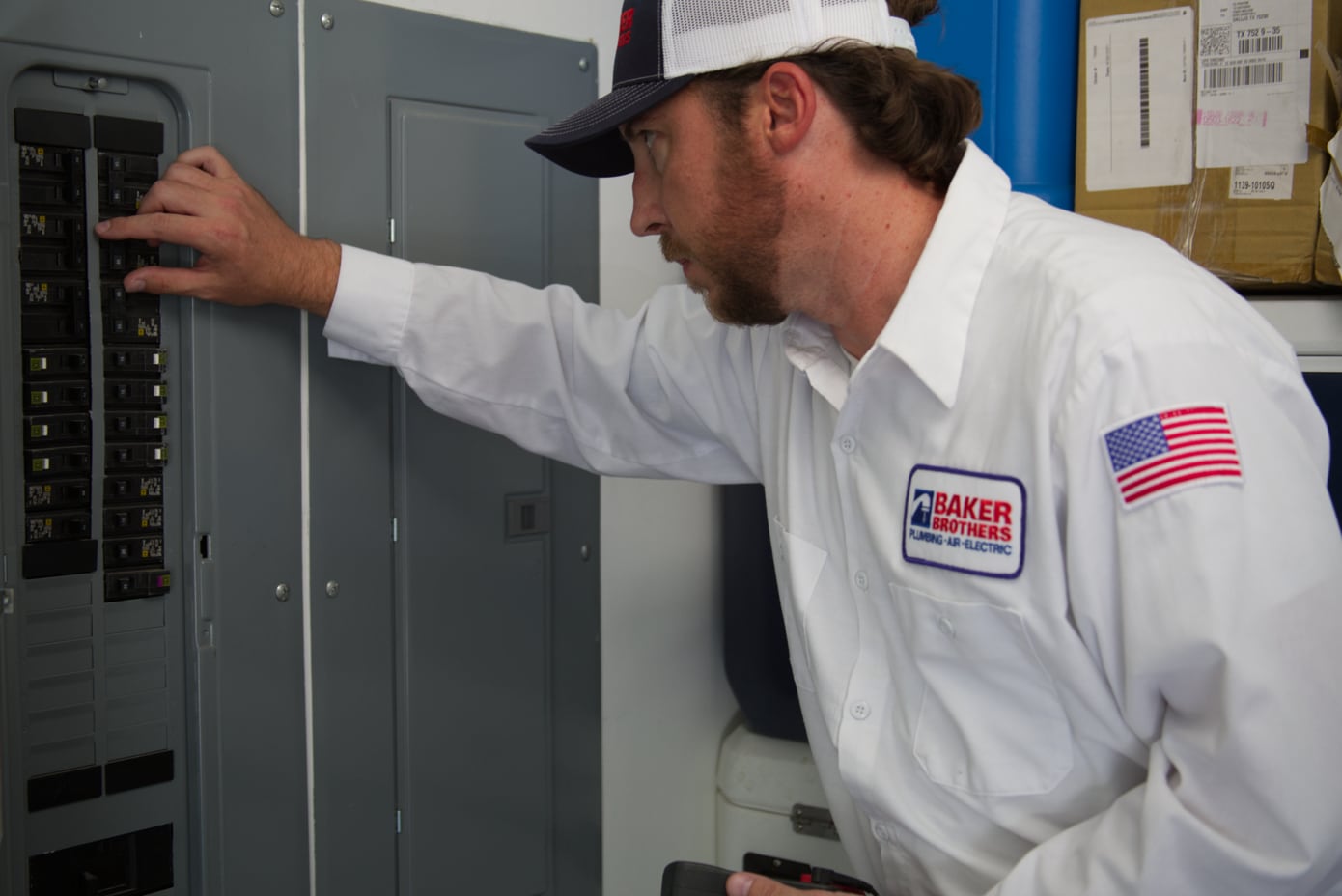
TL;DR: A high-efficiency AC system doesn't automatically need a bigger electrical panel. What actually triggers an upgrade is a narrower set of conditions: a panel already near its calculated capacity, a recalled panel brand an inspector won't pass, or a system large enough that the math just doesn't work. The difference between finding that out at the estimate and finding it out on install day is a permit delay and a few thousand dollars.
If you're getting quotes for a new AC system and a technician has mentioned your electrical panel almost in passing, it's worth understanding why before you sign anything.
The panel question now surfaces at the AC estimate stage instead of staying a separate electrical conversation you'd only have if something broke, because two things changed about the equipment itself. A decade or two ago, swapping a dying AC condenser for a new one was, electrically speaking, close to a non-event: pull the old unit, set the new one on the same pad, land the same wires on the same disconnect, done. That's not automatically true anymore.
First, the efficiency floor moved. Under U.S. Department of Energy regional minimum efficiency standards that took effect January 1, 2023, every new AC system sold in North Texas has had to clear 14.3 SEER2 for smaller systems and 13.8 SEER2 for larger ones, and plenty of homeowners are choosing to go well past the minimum (into the 18 to 20-plus SEER2 range) for the long-run savings in a climate that runs the compressor close to eight months a year. Second, how those higher-efficiency systems actually run changed. A growing share of them use variable-speed or inverter-driven compressors instead of the single-speed compressors that were standard for decades. Those compressors ramp output up and down to match the load instead of switching on at full blast and cycling off, which is genuinely good news for comfort and energy use. But the equipment doing that ramping, along with variable-speed blower motors and, in some installations, added electric backup heat strips, adds up to a different electrical picture than the system it's replacing.
None of that means a panel upgrade is now standard, just that the question is worth asking before the crew shows up, since the answer depends on what's already on your panel, not just what's going into your backyard.
Central air conditioners are rated in tons of cooling capacity, and the practical way to think about electrical draw is a rough rule of thumb: each ton of cooling capacity typically pulls somewhere in the range of 6 to 12 running amps, depending on the system's efficiency and compressor type.
System Size | Typical Running Amp Draw | Common Breaker Size |
|---|---|---|
1.5 ton | 15-20 amps | 20-30 amp |
2 ton | 18-25 amps | 25-35 amp |
2.5 ton | 20-30 amps | 30-40 amp |
3 ton | 25-35 amps | 35-50 amp |
4 ton | 35-50 amps | 50-60 amp |
5 ton | 40-55 amps | 60-70 amp |
A 3-ton system, common in a mid-size DFW home, might draw somewhere around 25 to 35 amps under load. The larger 4- or 5-ton systems common in the bigger, older homes that tend to drive full-system replacements across McKinney, Allen and Plano run higher still. These are industry rule-of-thumb ranges compiled from HVAC trade sources (AC Direct and Strickland Heating & Air, 2026), not a single manufacturer's nameplate spec.
The more precise number comes from the load calculation an electrician runs under NEC Article 220 (220.82 covers most single-family homes), which adds every major fixed load in the house (HVAC, water heater, range, dryer, general lighting and receptacle circuits) against the panel's rated capacity. Code treats HVAC as a continuous load, calculated at 125% of its nameplate rating rather than the raw spec-sheet number, so a panel that looks like it has headroom on paper can still come up short once the real numbers are run.
One piece of good news: inverter-driven compressors generally draw less at startup than the single-speed compressors they replace, since they ramp up gradually instead of hitting full locked-rotor amperage the instant they switch on. That lowers the peak-load spike a panel has to absorb, which is one reason a variable-speed upgrade sometimes clears a panel that a same-tonnage single-speed replacement wouldn't have.
In practice, three things push a panel upgrade from optional to necessary, and none of them is simply "the new system uses less energy."
The panel is already near its calculated capacity. This is the most common trigger, and it's almost always a symptom of an older, smaller-amperage panel carrying more electrical load than it was ever sized for: a 100-amp panel in a home that's since added a second AC system, an EV charger or a room addition has less headroom than it looks like it does on the outside. Run the new AC load through the NEC calculation and the total can push past what the panel is rated to deliver safely.
The existing panel is a recalled or known-hazard brand. Federal Pacific (Stab-Lok), Zinsco and certain Challenger panels were common in Dallas-Fort Worth homes built through the 1970s and 80s, and their breakers have a documented history of failing to trip during an overload: power keeps flowing instead of shutting off. A licensed electrician who spots one during a pre-install check will flag it regardless of the AC system going in, and increasingly, so will a home insurer. Our Federal Pacific and Zinsco guide covers what makes these panels dangerous and how to identify one. The AC install doesn't create this problem. It just brings an existing one to light.
A permit inspector requires it. Wherever a panel upgrade genuinely appears to be needed, the inspection process is going to catch it before the job closes out, even if it wasn't flagged going in. That's not a Baker Brothers policy call; it's how the permit and inspection process is supposed to work, and it's worth knowing that going in rather than discovering it when an inspection gets held up.
"Before a new AC installation, we recommend inspecting the electrical panel to confirm it has the condition and capacity to safely support the added load. Aging components, oxidation, and increased household demand can all affect a panel's performance, so this step ensures the new system runs safely and efficiently from day one." - James Sotero, VP of Electric
A home built in the 1970’s and 80’s commonly has a 60- or 100-amp panel, sized for a house with one central AC unit, an electric range and considerably fewer plugged-in appliances than a modern household runs today. Over the decades since, that same panel has often picked up a garage subpanel, a pool pump, maybe a workshop or a home office addition: each one a legitimate load added to a panel that was never resized to match. None of that shows up as a problem until something triggers the question, and a new AC system, especially a larger or higher-efficiency one, is exactly the kind of load that triggers it.
"Our HVAC technicians see a lot of panels that were built for the electrical demands of 30 or 40 years ago, not today's high-efficiency systems. Things like a 100-amp service, breakers that are warm to the touch, or signs of corrosion tell us the panel needs a closer look before we touch the AC unit." - Roger Frosini VP of HVAC
"Had a recent call for HVAC service to a home that had a 15+ year old system and an even older panel. Our approach is to assess the fix to the immediate problem, then step back and evaluate the entire system. On older equipment, that means being upfront about what continued repairs could cost over time and making sure any replacement is set up for long-term, safe performance, starting with the electrical panel." Matt McFarland HVAC Technician
Homes in these newer subdivisions are typically wired with 150- or 200-amp service from the start, anticipating more electrical demand. A straightforward AC swap in one of them rarely runs into a panel that's already near capacity, a recalled breaker brand or a size flag from a permit inspector, the three conditions that actually force an upgrade. Age of the home, more than the city it's in, is usually the better predictor of whether this conversation needs to happen at all.
If a panel upgrade turns out to be necessary, it's a defined process, not a guessing game. A licensed electrician pulls a permit with the city, the power gets shut off at the meter for a period of hours while the panel is swapped, and a modern, code-compliant panel (commonly upgraded to 150 or 200 amps in an older home) goes in its place. In the DFW area, that process typically also involves coordinating the temporary service disconnect with Oncor. The AC installation itself usually proceeds on the same visit or shortly after, once the panel has passed inspection.
For homeowners who end up needing a panel upgrade anyway, some choose to use the opportunity to move to a smart panel rather than a like-for-like replacement. Baker Brothers is an authorized SPAN installer, which is worth a conversation if you're already having the panel opened up and want circuit-level visibility or easier headroom for a future EV charger or solar addition.
The single best way to avoid a mid-install surprise is to ask about panel capacity as part of the AC estimate itself, not after the crew has already started. A few specific things worth asking a technician, in plain language:
A technician should have straightforward answers to all four, generally on the same visit. That's the standard worth expecting: the panel's actual rating shown or pulled up, not a guess, and a firm number in writing before anything gets touched, whether that number includes a panel upgrade or confirms one isn't needed.
How do I know if my electrical panel is too small for a new AC system? The clearest warning signs are a panel rated below 100 amps, a panel that's already tripping breakers under today's load, or a documented recalled brand like Federal Pacific, Zinsco or certain Challenger models. The only way to know for certain is a load calculation run against the specific new system, which a licensed electrician can do as part of the AC estimate.
Does every AC replacement require a panel upgrade? No. Most straightforward, like-for-like AC replacements, especially in homes that already have 150- or 200-amp service, don't trigger a panel upgrade. It becomes necessary when the panel is already near its calculated capacity, carries a recalled breaker brand, or when a permit inspector requires it for code compliance.
What amperage panel do I need for a new high-SEER AC system? There's no single answer that applies to every home, since the right size depends on total household load, not just the AC system alone. As a general benchmark, most homes built in the last 15 years have 150- or 200-amp service, which typically has room for a modern high-efficiency system. Older homes with 60- or 100-amp panels are more likely to need an upgrade, but the only accurate answer comes from a load calculation specific to your home.
Can I still install a new AC system if I have a Federal Pacific or Zinsco panel? A licensed electrician or permit inspector is very likely to flag a Federal Pacific (Stab-Lok) or Zinsco panel regardless of what AC system is going in, given their documented history of breakers failing to trip during an overload. In practice, this usually means the panel gets replaced as part of the project rather than around it. See our full breakdown of why these panels are considered dangerous and uninsurable for more detail.
What's the difference between a panel replacement and a service upgrade? A panel replacement swaps the physical panel and breakers, generally at the same amperage rating the home already has. A service upgrade increases how much power comes into the home from the utility (for example, going from 100-amp to 200-amp service), which requires new service-entrance wiring and, in the DFW area, coordination with Oncor in addition to the local building permit. A panel upgrade ahead of a new AC system can involve one, the other or both, depending on what the load calculation shows.
Baker Brothers Plumbing, Air & Electric is a licensed plumbing, HVAC and electrical contractor serving the Dallas-Fort Worth metroplex. James Sotero serves as the Vice President of Electrical at Baker Brothers, overseeing electrical services throughout the company’s service area. As the company’s Responsible Master Electrician, James brings nearly 30 years of experience in the electrical field. His extensive knowledge and leadership help ensure that every electrical service is completed with safety, quality, and the needs of the homeowner in mind
This piece reflects Baker Brothers Plumbing, Air & Electric's professional perspective on electrical panel capacity and AC installation across its Dallas-Fort Worth service area, combined with the National Electrical Code's Article 220 load calculation framework, published safety history on recalled panel brands and third-party cost data (Angi, 2026). The amp-draw-by-tonnage figures in the table above are industry rule-of-thumb ranges compiled from two HVAC/electrical trade publications (AC Direct and Strickland Heating & Air, both cited below), not a single manufacturer's nameplate spec. An actual installation's minimum circuit ampacity always comes from that specific unit's nameplate and the electrician's load calculation, not this table. No Baker Brothers-specific pricing is published in this piece beyond what the company has approved for public release.
Last updated: September 30, 2026 | Published: September 2026
-

Open Mon-Sun 7am to 7pm
JIMMIE DALE, JR. M-30505 | TACLB00052136E | TECL 33750
Baker Brothers Dallas
2615 Big Town Blvd
Dallas, TX, 75150
Phone: 214-892-2225
Baker Brothers Arlington
7315 E Commercial Blvd
Arlington, TX 76001
Phone: 817-595-0116
Baker Brothers McKinney
7300 State Highway 121, Suite 300,
McKinney, TX 75070
Phone: 972-486-9882
Baker Brothers Keller
9500 Ray White Rd, Suite 200,
Keller, TX 76244
Phone: 817-900-3836
About Us :: Contact Us :: Blog :: Careers :: Family Plan :: Service Areas :: Sitemap :: Notice at Collection :: Your Privacy Choices :: Privacy Policy :: Terms of Use :: Financing
© 2026 Baker Brothers Plumbing, Air & Electric. All Rights Reserved